Imagine a device which could replicate any taste. Millions of dishes, drinks, desserts and snacks and your fingertips or, more accurately, at the tip of your tongue. Introducing the Norimaki Synthesizer, a device which, using electricity, electrolytes and 5 different gels, can produce flavours directly onto your tongue. So how does it all work?
I love Lego. Always have. I remember having a big bright red box containing hundreds of pieces when I was younger of varying colours and shapes. With its simple (yet indestructible) design, Lego is a fantastic children’s toy for promoting curiosity in developing years. But it turns out, Lego has some cool properties which interests physicists (and sometimes the odd chemist) even today.
Around 60 million coffee machines are sold each year. A coffee machine is great for creating a quick drink with a fairly consistent taste, meaning the coffee produced should taste the same each time. And yet, two espressos, despite being made with the same ingredients and by the same machine, can taste different.
There’s many factors which can influence the variation in a coffee’s flavour: water quality, ratio of coffee to water, temperature. This study focused on the extent to which coffee beans were ground and how this impacted the flavour, and how what implications this would have on industry.
It was recently Bonfire night (otherwise known as Guy Fawkes Night) so my father and I went to watch the local annual fireworks display. About part-way through I started to wonder how they work. How are such vibrant colours produced? How high do they explode and how is this calculated?
Fireworks! The green, red and gold sparks stand out particularly well on a black background.
I recently gave an academic lecture at my school on the melting point of chocolate, a topic which came from a post I wrote earlier this year.
My academic lecture was part of my school’s “Academic Fortnight”, 2 weeks of short 15 minutes morning lectures before lessons by student volunteers and external speakers from Portsmouth University (our local university).
Below, I’ve attached my slides and my talking points, though I largely speak ad-lib so they’re not very long or detailed:
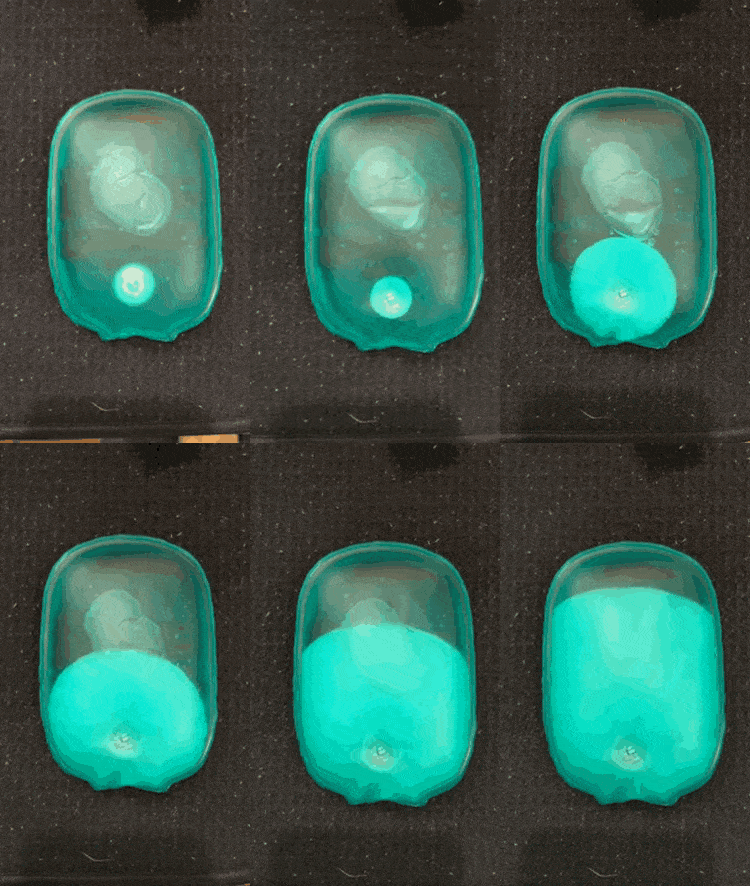
As we go into winter, it’s time to start pulling scarves and fluffy coats out the wardrobe, and keeping hand warmers in our pockets. If, like me, you like getting value for money, you might consider getting a reusable hand warmer instead of a one-time use one. They work quickly and effectively: simply snap the metal plate and wait for the crystals to grow and your hands to warm.
But how does it work? A wonder of chemistry, clearly. But some keywords are saturated (well, actually supersaturated), instability, crystalisation and exothermic. You can probably piece together a rough idea of what happens, so below I’m going to go into more depth and detail!
Moving into my final A Level year of chemistry, my class has started to cover optical isomerism. Part way through the lesson the teacher mentioned, as a side note, Turin and his work on explaining why we smell what we smell. I thought this sounded interesting and I’ve recently spent some time looking a little more into his work.
Luca Turing, biophysicist
Luca Turin is a biophysicist and is well known for his work on the vibrational theory. His book, The Secret of Scent, details Turin’s work on perfumes, from his own history to his vibration theory about how we, as humans, smell. He has worked in academia for many years, working at University College London (UCL), Massachusetts Institute of Technology (MIT) and most recently in the neurobiology division at the Biomedical Sciences Research Center (BSRC) Alexander Fleming.
Turin’s book, The Secret of Scent.
There are two common theories which both attempt to explain why things smell the way they do: the vibration theory of olfaction (by Turin), and the shape (docking) theory of olfaction. Below, I will look into both of them, the basic principles, evidence for both theories and issues with each theory.
Earlier this year I spotted the Cambridge Chemistry Challenge (for Lower Sixth students studying chemistry at A Level) online, and I decided to ask my chemistry teacher to enter myself and few other fellow students who wanted to give it a try.
The Cambridge Chemistry Challenge (C3L6) is a 90 minute long paper filled with questions around AS level but designed to stretch students by asking questions in ways students haven’t seen before or going beyond the normal curriculum. The paper is split into two sections: organic and inorganic with there being (normally) 3 questions with many different parts (going up to part i and part j sometimes!). I did find this a bit frustrating sometimes when not being able to get one part of the question meant you couldn’t answer following parts.
Dmitri Mendeleev, contributed a bunch to the periodic table.
Despite being tricky, I found the questions more interesting and engaging than ordinary A Level questions in the way they got you to think about things in different ways. I especially like how they give a lot of background to questions- this year celebrates the 150th anniversary of the periodic table so many of the questions were based around Mendeleev. This is important to helping students develop an understanding about the importance, practical uses, and even some of the history of chemistry.
In the end I managed to get a silver award! I think that C3L6 is a great opportunity and I’m fully planning to promote it to the aspiring chemists in the year below.
Thanks for reading! If you enjoyed this, check out some of my other posts:
I’ve had an allotment for a couple of years now. Throughout the year, my family and I grow a variety of plants, including potatoes, peas, beans and carrots- the usual. Every year we sow and water the seeds, and the plants grow. And every year comes the same problem anyone trying to grow anything has had since the dawn of agriculture: bugs. So, to deal with this, mankind invented pesticides. But issues with pesticides creates demand for more natural solutions- could coffee be one?




 Distilled Thoughts