Norimaki Synthesizer Taste Display: a tasty sample of science

Imagine a device which could replicate any taste. Millions of dishes, drinks, desserts and snacks and your fingertips or, more accurately, at the tip of your tongue. Introducing the Norimaki Synthesizer, a device which, using electricity, electrolytes and 5 different gels, can produce flavours directly onto your tongue. So how does it all work?

Continue reading “Norimaki Synthesizer Taste Display: a tasty sample of science”

Applying to Cambridge Natural Sciences, a guide

This blog post will walk you through to applications process for Natural Sciences at Cambridge, sharing my advice and personal experiences. I currently hold an offer to study NatSci but, due to the current situation of all A Level exams being cancelled everything is a little up in the air currently so with all my free time I’ve decided to sit down and write this guide.

This post will contain advice for applying to university in general, specific Oxbridge advise, and even more specific Physical Natural Sciences at Cambridge advise.

Continue reading “Applying to Cambridge Natural Sciences, a guide”

Michael Crichton, an author to remember

Michael Crichton, perhaps best remembered as creator of the sensational Jurassic Park, has quickly become one of my favourite writers. He wrote over 30 novels (not including his short fiction and screen writing work) throughout his lifetime, many of which became best-sellers. Not only that, but he was also a graduate of Harvard Medical school, with his many years studying medicine providing an ideal basis for the science fiction books he would later write.

So, without further adieu, here’s my top 5 reasons why Michael Crichton is an author whose work should, and will, remain relevant.

The feared T-Rex, a monster brought back from extinction by Crichton’s genius.
Continue reading “Michael Crichton, an author to remember”

Taking Lego down to near absolute zero with the first Lego cryonaut

I love Lego. Always have. I remember having a big bright red box containing hundreds of pieces when I was younger of varying colours and shapes. With its simple (yet indestructible) design, Lego is a fantastic children’s toy for promoting curiosity in developing years. But it turns out, Lego has some cool properties which interests physicists (and sometimes the odd chemist) even today.

Colourful deathtraps for the feet
Continue reading “Taking Lego down to near absolute zero with the first Lego cryonaut”

The standardisation of espresso flavour using maths

Around 60 million coffee machines are sold each year. A coffee machine is great for creating a quick drink with a fairly consistent taste, meaning the coffee produced should taste the same each time. And yet, two espressos, despite being made with the same ingredients and by the same machine, can taste different.

There’s many factors which can influence the variation in a coffee’s flavour: water quality, ratio of coffee to water, temperature. This study focused on the extent to which coffee beans were ground and how this impacted the flavour, and how what implications this would have on industry.

Coffee- what would we do without it?
Continue reading “The standardisation of espresso flavour using maths”

A look at the science behind fireworks

It was recently Bonfire night (otherwise known as Guy Fawkes Night) so my father and I went to watch the local annual fireworks display. About part-way through I started to wonder how they work. How are such vibrant colours produced? How high do they explode and how is this calculated?

Fireworks! The green, red and gold sparks stand out particularly well on a black background.
Continue reading “A look at the science behind fireworks”

Academic Lecture on the melting point of chocolate

I recently gave an academic lecture at my school on the melting point of chocolate, a topic which came from a post I wrote earlier this year.

My academic lecture was part of my school’s “Academic Fortnight”, 2 weeks of short 15 minutes morning lectures before lessons by student volunteers and external speakers from Portsmouth University (our local university).

Below, I’ve attached my slides and my talking points, though I largely speak ad-lib so they’re not very long or detailed:

Continue reading “Academic Lecture on the melting point of chocolate”

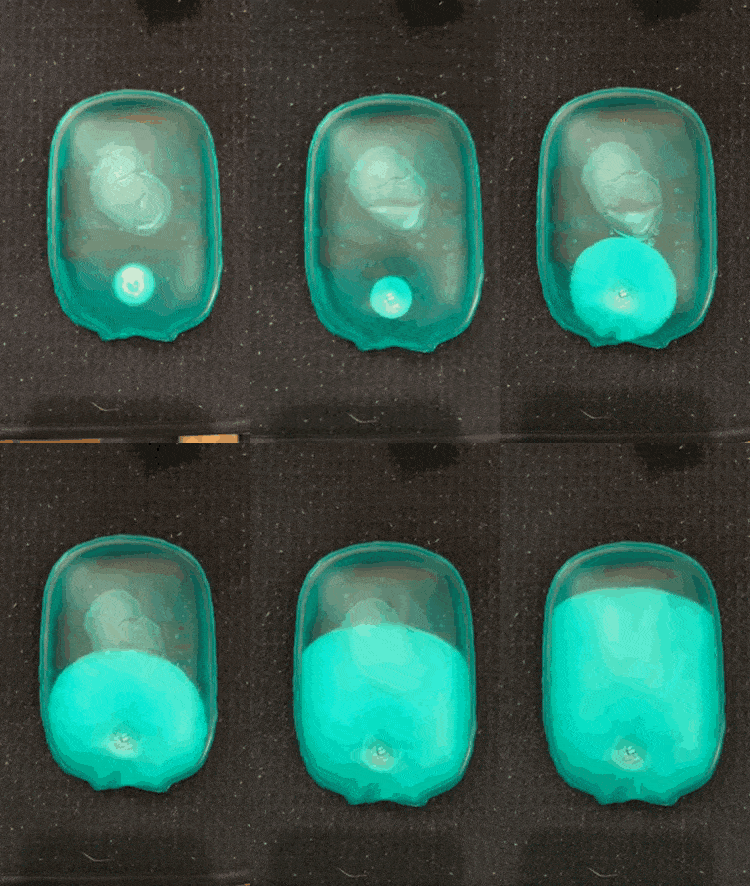
How do reusable hand warmers work?

As we go into winter, it’s time to start pulling scarves and fluffy coats out the wardrobe, and keeping hand warmers in our pockets. If, like me, you like getting value for money, you might consider getting a reusable hand warmer instead of a one-time use one. They work quickly and effectively: simply snap the metal plate and wait for the crystals to grow and your hands to warm.

But how does it work? A wonder of chemistry, clearly. But some keywords are saturated (well, actually supersaturated), instability, crystalisation and exothermic. You can probably piece together a rough idea of what happens, so below I’m going to go into more depth and detail!

Continue reading “How do reusable hand warmers work?”

RollerCoaster tycoon’s sandbox: the physics and engineering involved

I’ve always loved to play RollerCoaster Tycoon. The basic game play involves being able to design and run your own theme park, controlling elements such as park, ride and merchandise prices, what roller coasters are available, theme park design and layout, and more.

A scene from inside a later version of the game.
Continue reading “RollerCoaster tycoon’s sandbox: the physics and engineering involved”

Should the breakthrough prize be given for unproven physics?

I’m a little late off the block with this one, but it’s something I heard about through the Physics World podcast a little while ago. To give some context, the Breakthrough prize (worth $3m) was recently awarded to 3 physicists for their work on “supergravity”.

Supergravity attempts to unify all of physics by introducing a graviton, a spin-2 particle which would help combine the theory of relativity with super symmetry through all of space-time. Needless to say, it if were correct, it would be a huge leap for physics. The issue? It has never been proven. Despite all its potential, the lack of experimental proof from the LHC (Large Hadron Collider) casts doubt upon the theory.

So when the breakthrough prize was awarded to the 3 physicists- Sergio Ferrara (CERN), Daniel Freedman (Massachusetts Institute of Technology) and Peter van Nieuwenhuizen (Stanford)- there was undoubtedly going to be some controversy over it. Should the breakthrough prize be given to unproven physics?

On one hand, no. Physics is a field of research and careful experiments. Experimental data must support a theory for the theory to be accepted as true, or else the theory is nothing more than a wild guess or speculation. The lack of proof to support supergravity reduces it to a guess. A very mathematical guess, but a guess none the less. Giving such a large and important prize for something that looks nice but has no practical use, as as commented by others, sends out the wrong idea, that the breakthrough prize is awarded for popular ideas than correct ideas. In the long run, this may push physicists into creating wild speculation rather than focusing on proven, albeit less “interesting”, physics.

On the other hand yes. The work these 3 physicists did was pioneering, and a brillinat display of maths. Despite being unproven, the theory opens up new ways of thinking. The first steps towards forming a correct (or more accurate theory) begins with the ground work being laid out first, and then other physicists taking those ideas and developing them further, increasing the potential for the formation of new, more accurate theories in the future. The work on supergravity may be something that is important to physics in the long run as opposed to something that can be proven exactly correct or proven immediately.

I personally think supergravity deserved to be awarded the breakthrough prize. For physics which demands rigorous experimental proof, the Nobel prize already exists. The breakthrough prize, I believe, exists to reward physicists who work on research that may fall outside the Nobel prize region and otherwise would not receive as much acknowledgement as it should.